A First-Time Host’s Plan for a One-Room Festival
A one-room festival plan helps first-time hosts shape a clear theme, choose a running order, and give guests an inviting beginning and ending.
The common mistake in a one-room festival plan is booking appealing acts before deciding what the gathering is about. The result can be a string of good moments that feel unrelated, leaving guests unsure why they belong together. Start with a central thread, then choose a format that lets each part of the room’s programme contribute to it.
A one-room festival does not need a grand theme or elaborate production. It does need a recognizable progression: a reason to arrive, something to settle into, and a final moment that feels like an ending. For a first-time host, the practical choice is usually among three approaches: a guided programme, an open salon, or a hybrid.
What should the central thread do?
The central thread is the idea that connects the programme without forcing every contribution to look alike. It might be a question, a place, a material, or a shared activity. “How do we listen to a neighborhood?” can connect a short sound piece, a conversation with a local musician, and a group listening exercise. “Creative community” is broader and harder to turn into specific choices.
Write the thread as one plain sentence. Then ask of each proposed event: what does this add to the idea, and what will guests notice because it is here? If you cannot answer both, the item may be enjoyable but belong in another gathering. That is not a judgment of its quality; it is a way to protect the shape of this one.
Keep the thread flexible enough to accommodate different forms. A festival can move from spoken word to a small demonstration to quiet participation, as long as the transitions make their connection legible. Avoid explaining the theme at length from the stage. A brief welcome, a few clear program notes, and thoughtful sequencing can do more.
Which format suits a first-time host?
Would a guided programme suit your room?
A guided programme has a visible sequence and a host who introduces each section. It suits a modest audience, scheduled performers, and a room where people need cues about when to listen or participate. Guests can arrive knowing that the gathering has a shape; the host carries more responsibility for timing and transitions.
This option works particularly well when the central thread is expressed through distinct contributions. For instance, a room devoted to everyday repair might move from a short story about a mended object to a demonstration of visible stitching, then to a conversation about what people choose to keep. The sequence does not need a formal stage, but guests should be able to tell where attention belongs.
Would an open salon suit your room?
An open salon offers a loose structure: a short welcome, several activity stations or conversation prompts, and an informal closing. It suits a gathering where people are expected to circulate, make things, or talk in small groups. It can feel warm and exploratory, but it asks the host to make the room’s purpose and available choices easy to understand.
Keep the number of simultaneous activities modest. In one room, a lively discussion can make a quiet listening corner unusable, while materials spread across every surface can obscure where guests should gather. Give each activity a distinct place and a concise sign that says what to do and whether people may join at any point.
Could a hybrid give you the right balance?
A hybrid combines a few shared moments with open time between them. It suits a mixed programme: perhaps a common opening, an interval for a guided making activity, and a final group reflection. The shared moments establish a common thread; the open sections let guests participate at their own pace.
Hybrid formats require clear signals. Tell guests when an activity is scheduled, whether late arrivals can join, and what to do during open time. If the room has no separate area, avoid running a quiet performance and a noisy drop-in activity at once. A simple change in lighting, seating arrangement, or host announcement can mark a transition, provided the room’s equipment and venue rules allow it.
How do you choose between the three?
Choose by matching the programme’s demands to the room and your own hosting capacity, not by picking the format that sounds most impressive. Ask these questions before confirming contributors:
- Does the audience need to hear one thing together? If so, lean toward a guided programme or a hybrid with a clear shared opening.
- Will guests need to move between activities? If circulation is central, consider an open salon, but keep paths and activity areas understandable.
- How much stage direction can you provide? If you are the only host, a simple sequence may be easier to hold than several activities happening at once.
- Can the room support the sound and attention the format requires? If not, reduce simultaneous activity or choose one focus at a time.
- What should guests remember as they leave? If the answer is a shared performance or conversation, make that the closing point. If it is something they made or discussed, leave room to gather around it.
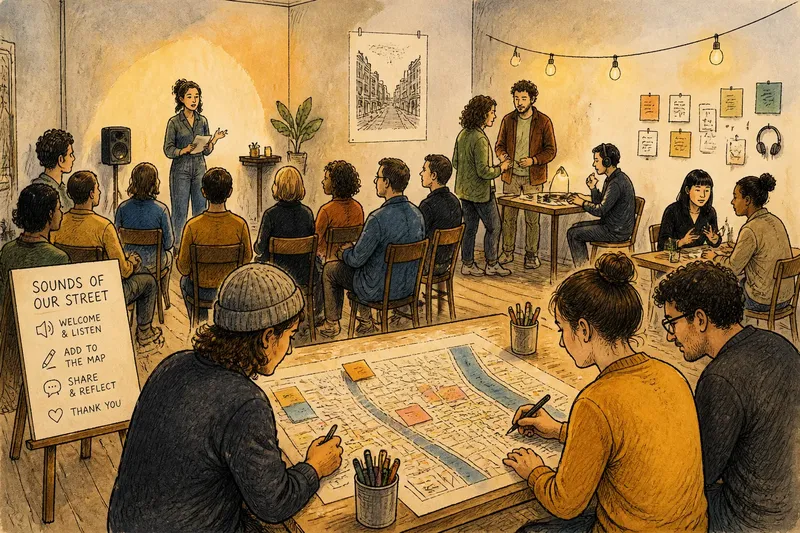
Say you are planning an invented festival about the sounds of a familiar street, and the room has chairs, a small speaker, and one central table. You could choose a hybrid: welcome everyone with a short field recording, invite them to add words or sketches to a shared map during the open section, then close by reading a selection aloud. The expected observable result is that guests can connect the opening sound to the contributions on the map, rather than encountering three unrelated activities.
How should the festival begin, develop, and end?
Beginning: Make arrival easy. Put the event name and a short description where guests enter, and have the host greet people before asking them to take part. Open with a concise welcome that explains the central thread, how the programme works, and whether guests may join in or simply observe. Do not start with a long account of how the festival came together.
Middle: Let the programme deepen or change mode. A guided sequence might move from listening to discussion; an open salon might begin with a shared prompt before guests split into activities. Give every contributor a clear introduction, and tell guests what to notice or do. If a section depends on participation, offer a low-pressure way to watch first.
End: Bring attention back to the thread. A closing can be a final performance, a short round of responses, or a look at what the group has made. Name what happens next in the room—whether guests are invited to stay briefly or the programme is over—so the ending does not dissolve into uncertainty. Leave logistical announcements short and separate from the last artistic or shared moment.
What details help the room feel coherent?
Use the room’s existing features rather than trying to disguise them. Arrange chairs to suit the main activity, reserve a clear route to the entrance, and keep the host’s speaking position visible. If guests need to see a screen, demonstration, or shared table, check sightlines from the back and from the places people are likely to stand.
Give the programme a small visual language: consistent headings on signs, one color for activity cards, or a simple printed running order. These cues help guests orient themselves without turning decoration into a separate project. A handwritten sign can be enough if it is readable and placed where a decision is needed.
Coordinate with the venue about room access, permitted equipment, furniture, noise, and any accessibility requirements. Venue instructions and local rules determine what is allowed; ask the person responsible for the space when a detail is unclear. For electrical, structural, or other safety-sensitive setups, leave the work to qualified venue staff rather than improvising.
What is not worth the effort?
For a first gathering, elaborate stage dressing, a custom logo for every activity, and a tightly scripted line for every transition are often more work than the room needs. Spend that effort on a clear welcome, legible signs, a workable running order, and a host who knows how to bring attention back when the room wanders.
Keep a compact run sheet with the sequence, the person responsible for each contribution, the materials needed, and the cue that marks a transition. Share relevant details with contributors before the event, including how they will be introduced and what happens immediately after their slot. A useful one-room festival plan is not the most complicated one; it is the one that helps guests recognize the thread, take part at their own level, and understand when the gathering has reached its end.