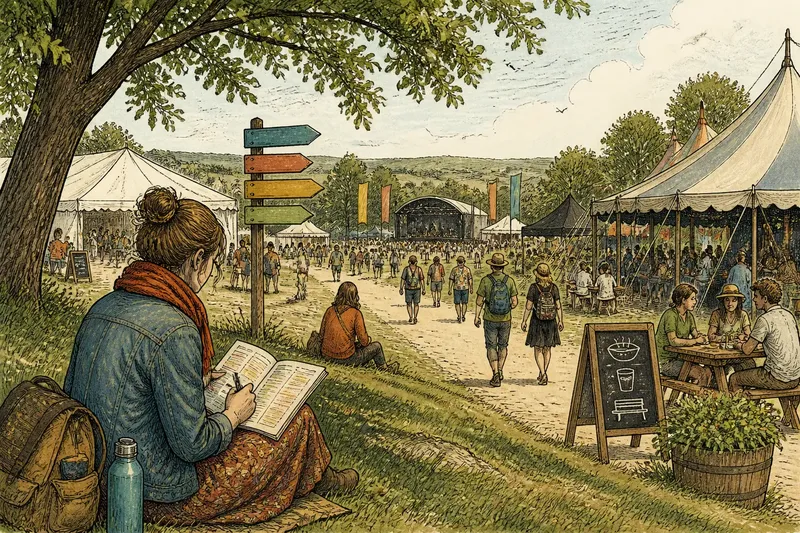
Open Grounds or Compact Venue: Two Ways to Find Your Bearings
Compare open grounds and compact festival venues to choose a setting whose routes, transitions, and landmarks fit the kind of day you want.
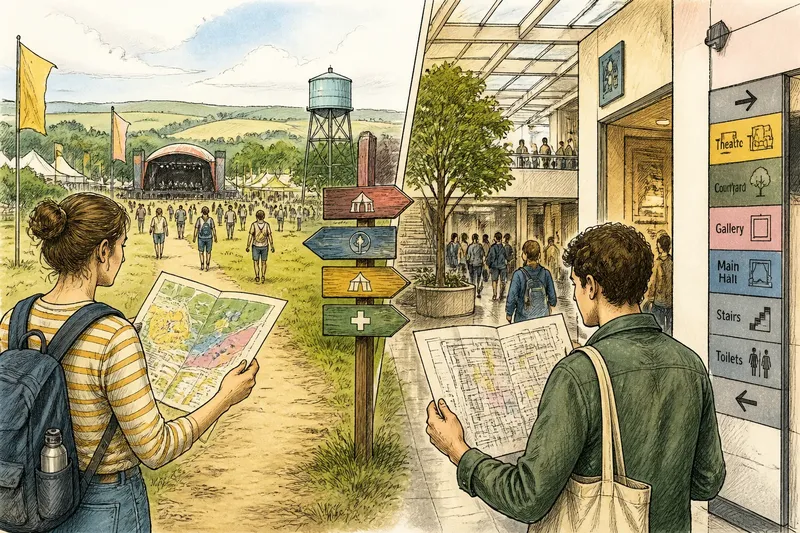
The common mistake when comparing festival venues is to treat a large map as a problem and a small one as an automatic convenience. For festival venue orientation, the real difference is how each setting helps you understand where you are and what moving between events feels like. Open grounds offer distance and visible landmarks; compact venues make nearby rooms and routes easier to hold in mind.
What does the venue’s scale change?
At open grounds, the landscape itself becomes part of the map. A line of trees, a slope, a water tower, or a distinctive stage roof can help you tell one area from another. These landmarks may remain visible across long stretches, but the route to them can cross paths, lawns, or temporary structures that look similar at first glance.
A compact venue often gives you a different kind of clarity. A theater lobby, courtyard, gallery corridor, and main hall form a sequence of spaces close enough to connect mentally. You may orient yourself by doors, stairways, signs, or the sound coming from a room just beyond the hall.
Neither form is inherently easier. Open space can make direction visible while leaving distance hard to judge. Compact space can make distances feel manageable while offering several turns or entrances that are easy to confuse.
How do transitions shape the day?
Moving between events outdoors can feel like a distinct part of the programme. The walk may provide a view of the site, a change in sound, or a gradual shift from one crowd to another. It also means that a schedule with events in far-apart areas asks you to account for the character of the route, not only the listed start times.
In a compact venue, transitions often happen through thresholds: out of a performance room, across a lobby, then through another doorway. That can keep events connected, but corridors and entrances may become busy at changeover. A nearby event can still require a pause to locate the correct room or move through a crowd.
Say you have just watched a poetry reading in a small hall and the next event is in an outdoor area beyond the site’s central path. If the printed map marks that path and a nearby sign names the destination, you can use those cues to choose a route without assuming the two venues are adjacent. In a compact venue, the equivalent decision may be to follow room labels rather than the crowd, which could be heading toward a different event.
Which setting suits the kind of day you want?
Think about the experience you want between scheduled events. Open grounds tend to make a festival feel like a collection of districts, with movement and changing views woven into the day. Compact venues tend to make it feel like a cluster of rooms, where a change in programme may come with a change in atmosphere but little change in the surrounding landscape.
- Choose open grounds if you enjoy recognizing distant landmarks and treating walks between areas as part of the occasion.
- Lean toward a compact venue if you prefer to keep the site in a small mental map and move between events through linked rooms.
- Check how the map names places. A clear distinction between stage names, building names, and entrances is more useful than decorative labels alone.
- Notice where routes meet. A central junction can simplify a sprawling site, while a lobby or courtyard can serve the same purpose in a compact one.
These are preferences, not promises about crowding or ease. A large outdoor site may have a legible central spine; a compact building may have several entrances and overlapping corridors. The venue’s actual layout matters more than its label.
What should you check before choosing?
Look at a venue map alongside the programme rather than reading either in isolation. Mark the areas where the events you care about take place, then notice whether they cluster together or sit on different sides of the site. This simple comparison shows whether the setting’s scale is likely to shape your transitions.
Also look for practical orientation cues: named gates, building entrances, numbered zones, or a clearly marked information point. If the map uses different names from the programme, note the connection before you arrive. For access routes, closures, or venue-specific rules, follow the organizer’s current information and any applicable local guidance.
It is not worth trying to memorize every path or room before the festival. A handful of reliable anchors—a main entrance, a central meeting point, and the name of your next area—usually gives you a workable sense of direction without turning the map into homework.
How does festival venue orientation differ in each setting?
Are open grounds harder to navigate?
Not necessarily: distant landmarks can make the overall layout visible, even when routes are long or similar-looking. Check whether the map identifies the paths and zones between those landmarks.
Is a compact venue always easier to learn?
Its connected rooms may be easier to remember, but multiple floors, entrances, or corridors can blur together. Room names and floor labels help distinguish spaces that sit close to one another.
What is the most useful point to locate first?
Start with the entrance you expect to use and identify a central landmark or information point from there. These anchors give you a reference for reading the rest of the map.
How can I compare two festival maps?
Find the events you hope to attend and trace the likely transitions between them on each map. Notice whether movement takes you across open areas or through connected interior spaces, then decide which pattern sounds more appealing.
How can the map become a useful companion?
Once you choose a setting, let the map support your attention rather than dictate every move. On open grounds, keep a landmark in view when practical and use named paths to confirm that you are heading toward the right district. In a compact venue, notice room labels at junctions and remember which entrance or lobby connects the areas you plan to visit.
Festival venue orientation is ultimately about matching the site’s spatial character to the day you want: movement through a landscape, or passage through a close-knit series of rooms. Before setting out, identify one dependable point of return on the map. That small reference can make an unfamiliar place feel legible without requiring you to plan every turn.