How a Festival Wristband Becomes a Shared Signal
A festival wristband can mark entry, preserve an event memory, or invite recognition. Learn what its design can—and cannot—tell you, and how to keep it.
The most common mistake with a festival wristband is assuming it means the same thing at every event. That can lead someone to mistake a souvenir for an admission credential, or to read a past access band as proof of current entry. A wristband’s role depends on the festival’s own rules and on what its wearer chooses to remember.
What does a festival wristband signal at the entrance?
At the gate, a festival wristband is an access credential: an item staff may use to identify attendees, distinguish pass categories, or show that admission has been completed. A woven band, paper strip, or plastic band can each serve that purpose, but the material alone does not tell you what access it grants or how long it is valid.
Some events use wristbands alongside mobile tickets or printed credentials; others use a different entry system. Follow the event’s instructions rather than inferring the rules from a band’s color, print, clasp, or texture. Those details may distinguish categories at one festival, but they have no universal code.
How does a festival wristband become a keepsake?
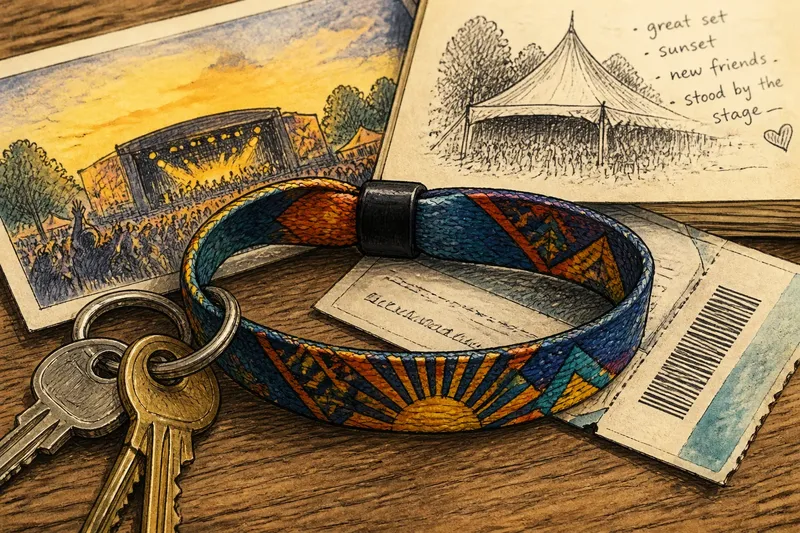
Once an event ends, its admission purpose may be over, but the band can stay with its wearer. Someone might leave it on briefly, put it in a drawer, or attach it to a key ring. In each case, the object can shift from practical identifier to personal reminder, though not everyone wants to keep one.
Details such as an event name, venue, or recognizable design can help a band call up a particular gathering. If the printed design is hard to place, keeping the band with a ticket, program, or short note can preserve the context. There is no need to turn a few souvenirs into a formal collection.
When does a saved band become a shared signal?
A wristband can open a conversation when another person recognizes its name or artwork. It may indicate a shared point of reference, but it cannot explain what the event meant to its wearer or establish how close two people are. Recognition begins with the exchange between people, not with the object alone.
Say you keep a woven band from a neighborhood music festival because its name remains legible. Later, someone spots it on your key ring and asks about it. You name the festival, and they say they attended too. The band has prompted an observable exchange of recognition; it has not, by itself, established a friendship or a complete account of either person’s experience.
What should you do with a festival wristband after the event?
First, follow the event’s stated rules for admission and access. Do not assume a band can be transferred, reused, or worn as proof of entry at another event. If the instructions are unclear, ask staff rather than relying on the band’s appearance.
Afterward, use these checks to decide what to do:
- Check comfort: If the band irritates your skin or interferes with an activity, remove it; if it is comfortable and you want to wear it briefly, keep it on.
- Check its context: If the event name or design identifies the occasion, keep the band on its own; if not, pair it with a ticket, program, or note naming the event.
- Check your reason for saving it: If it recalls a moment you care about, keep it; if you feel no attachment, let it go.
- Check the access rules: If the event says the band remains valid for a stated purpose, follow those instructions; if its status is unclear or the event is over, ask staff rather than treating it as current access.
- Check the material and local disposal options: If an appropriate recycling route accepts it, use that route; if not, follow local waste guidance or discard it as permitted.
- Check whether you want to display it: If seeing the band brings the event to mind, keep it somewhere you will notice it; if display would become clutter, store it with context or let it go.
Careful sorting, special display hardware, or trying to decode a design without event context is usually not worth the effort. A short note with the event name is enough if you want to remember where the band came from.
What do people ask about festival wristbands?
Can a festival wristband be reused?
Do not assume it can. Reuse and transfer rules depend on the event and credential, so check the event’s instructions or ask staff.
Does a wristband prove someone attended?
Not on its own. A band may be a souvenir or may have been obtained another way, so its appearance cannot give a complete account of when or how it was used.
Why do festival wristbands have different colors or materials?
An event may use its own colors or materials for practical or visual reasons. Those choices do not carry a fixed meaning across festivals.
How should I preserve a wristband as a souvenir?
Store it with a ticket, program, or short note that identifies the event. If it is uncomfortable or no longer needed for access, keeping it off your wrist is enough.
Why does a wristband’s meaning stay personal?
A festival wristband can serve an event’s entry system, remind someone of a gathering, or give another person a reason to ask a question. These roles can overlap, but none should be assumed from the object alone. The band’s design offers clues; the wearer’s account supplies the context.
For a festival wristband you are deciding whether to keep, start with its event-specific function, then ask whether the object still helps you remember or connect. If you save it, add enough context to place it later. If you let it go, keep the memory in whatever form suits you; the band is a token, not the experience itself.