The Packing List That Becomes a Burden
A festival packing list built around your actual plans keeps useful essentials close, cuts dead weight, and makes moving between events less tiring.
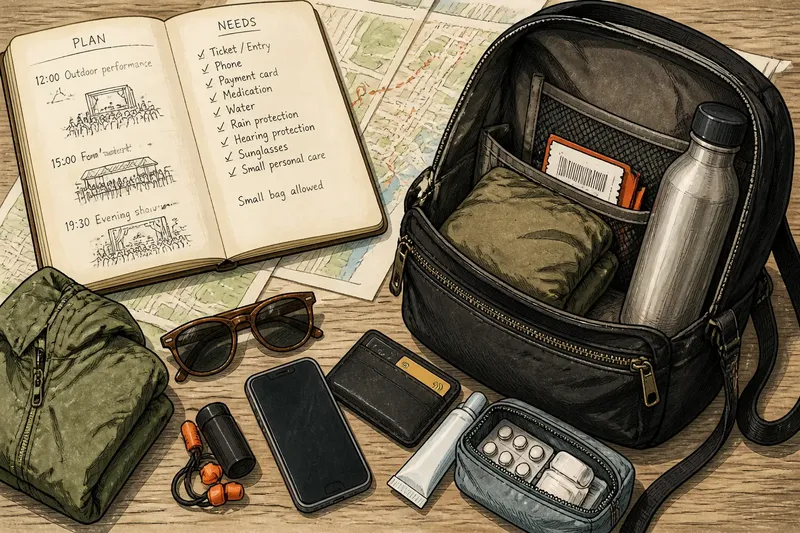
The most common festival packing mistake is bringing something for every possibility instead of choosing for the plans you actually have. A festival packing list that grows to cover every weather change, outfit idea, minor discomfort, and imagined emergency can turn a day of music or performance into a day spent guarding, carrying, and sorting belongings.
The answer is not to travel unprepared. It is to make each item earn its place by connecting it to a specific part of your visit. Start with the schedule and setting, then pack for the needs that follow. This keeps the useful things accessible and makes it easier to notice when a bag has become a collection of unlikely backups.
Why does the bag feel heavier than the day deserves?
A bag often becomes burdensome through accumulation rather than one obviously excessive item. A second layer seems sensible, then a spare shirt, a large toiletry pouch, a book for a possible quiet moment, and a collection of small “just in case” supplies. Each choice is easy to defend on its own. Together, they create weight, bulk, and more objects to keep track of.
That extra load can affect the experience even if it never feels dramatically heavy. It may be awkward to carry while standing, difficult to place under a seat, or slow to search when a ticket or water bottle is needed. Items can also compete for space with something acquired during the event, leaving the visitor to juggle rather than pay attention.
Ask what a difficult-to-carry item will help you do. If the answer is only “it might be useful,” identify the exact circumstance and consider whether there is a simpler response. A bulky sweater for an uncertain evening forecast may be less useful than a light layer that fits into the bag you already plan to bring.
How can you pack around the plans you actually have?
Use the day’s intended activities as the starting point, not a catalogue of everything that could happen at a festival. Consider the programme you plan to attend, how long you expect to be away from your base, what the venue permits, and the conditions you can check before leaving. A seated indoor performance, an outdoor afternoon, and an evening that moves between locations call for different belongings.
Write down the needs attached to each part of the plan. For a long stretch outdoors, shade or rain protection may matter. For a venue with assigned seating, a compact bag and ticket access may matter more than supplies for hours of standing. For a visit that includes a meal away from the grounds, a clean shirt might be useful; for a short stop between nearby events, it may not be.
Then group the items by purpose. A useful core often includes entry information, a phone, a way to pay, any personally needed medication, and a drink or other basic comfort if permitted and appropriate. Add weather protection, hearing protection, or a small personal-care item only when the setting or your own needs call for it. The exact contents depend on the event and the visitor; the point is to make the reason for each addition clear.
Say you plan to attend an outdoor afternoon performance, then walk to a nearby food market before returning for an evening show. You check the forecast and find a chance of light rain, and the venue allows a small personal bag. A packable rain shell, phone, ticket details, payment card, and any medication you need have direct jobs; a second pair of shoes and a full change of clothes do not fit the plan unless you have a specific reason to need them.
What problems show that your packing choices are off?
Why is it hard to find the thing you need?
A bag full of small pouches and loose objects makes simple tasks slower. The usual cause is packing by category—several grooming items together, several clothing items together—without considering which objects need to be reached quickly.
Keep the most-used items in predictable places: entry details and payment where you can reach them without emptying the bag, and personal supplies together in a small pouch. Avoid adding organizers that only create more layers. If a pouch stays closed all day and holds no essential items, remove it or reduce its contents.
Why are you carrying items that never leave the bag?
Unused belongings often signal that the list was written from possibilities rather than plans. The cause may be a vague worry—“I might need this”—without a likely situation or a reason this particular item is the best response.
Look at each item and name the moment it serves. If you cannot connect it to the schedule, expected conditions, a personal need, or a venue requirement, leave it out. For an item tied to a rare but serious personal need, make the decision carefully rather than treating it as ordinary optional clutter.
Why does the bag feel uncomfortable before the event begins?
Discomfort can come from a bag that is too large, poorly suited to the way you will move, or packed with items that shift around. A bag designed for a long hike may be more equipment than a short visit requires, while a tote can be awkward if you expect to keep both hands free.
Choose a carry style that fits your route and the venue’s rules, then place dense items close to your back and keep the load from sloshing around. If the bag still feels awkward when lightly loaded, changing the bag may help more than removing a useful item.
Why did the weather plan become a pile of clothes?
Uncertainty can prompt a separate outfit for every possible condition. The cause is often treating each forecast possibility as a reason to pack a complete backup rather than choosing one adaptable layer.
Check conditions close to departure and select clothing that can work across the expected range. A light rain shell over a comfortable base layer may be more practical than carrying several alternatives, but follow the forecast and your own comfort rather than assuming one combination suits everyone.
What should you leave behind?
Leave behind items that duplicate one another, serve only an imagined activity, or are easy to obtain if a real need arises and the event makes that option practical. A second charger, multiple bags of snacks, spare cosmetics, and extra accessories deserve a closer look when they have no distinct purpose in the plan.
Do not remove something simply because another visitor would not bring it. Personal medication, mobility aids, hearing protection, and other individual necessities are not clutter. The useful distinction is between an item that supports your actual needs and one added only to soothe an undefined worry.
It is usually not worth the effort to create a miniature emergency kit for every unlikely inconvenience. A pouch stuffed with tape, tools, spare batteries, and assorted remedies can take up space without matching the event’s rules or your likely needs. Keep only the supplies that are relevant, permitted, and appropriate for your circumstances.
How can you make a smaller list without missing something important?
Use a brief check in order, and let each question narrow the choices:
- What is the plan? Name the events, locations, and time away from your base that matter to the visit.
- What conditions are likely? Check the forecast, the venue’s setting, and whether you expect to sit, stand, walk, or move between places.
- What is required? Confirm entry details, bag rules, and any restrictions that affect what you can bring.
- What do you personally need? Set aside medication, accessibility items, or other essentials before judging optional belongings.
- What can serve more than one purpose? Prefer a layer or compact item that suits several planned moments over several single-use alternatives.
- What can stay behind? Remove duplicates and items that have no clear job in the visit.
Pack the selected items, then lift and carry the bag as you expect to during the event. This is a practical way to notice awkward bulk, shifting contents, or a strap that does not suit the route. It is not a reason to add more gear automatically: first ask whether the discomfort comes from the bag itself or from an item with no strong purpose.
What should you check before you leave?
Make one final pass for essentials and access. Confirm that you can reach your entry details, payment, phone, and any personal necessities without unpacking everything. Check that the bag closes, that loose items are contained, and that the belongings you chose fit the outing rather than a longer trip you are not taking.
If the plan changes, revise the bag in response to the change. An unexpected overnight stay or a move to a different venue may justify another item; a vague sense that something could happen usually does not. Keep the festival packing list tied to the visit in front of you, and you can carry what matters without letting preparation become the main event.
Before setting out, leave a little room for the practical surprises that belong to the day, such as a programme or a small purchase. That space is more useful than packing every possible backup, and it lets you respond to what actually happens rather than what an overfull bag predicted.